Ink Math: Convert Digital Text and Math to Realistic Handwritten Notes in 3 Seconds
Ink Math (aipen.ink) transforms kindergarten to PhD-level math into super realistic handwritten pages, where every stroke looks organically written on real paper by an actual person.
Render this equation free → 3 free pages. No card needed.
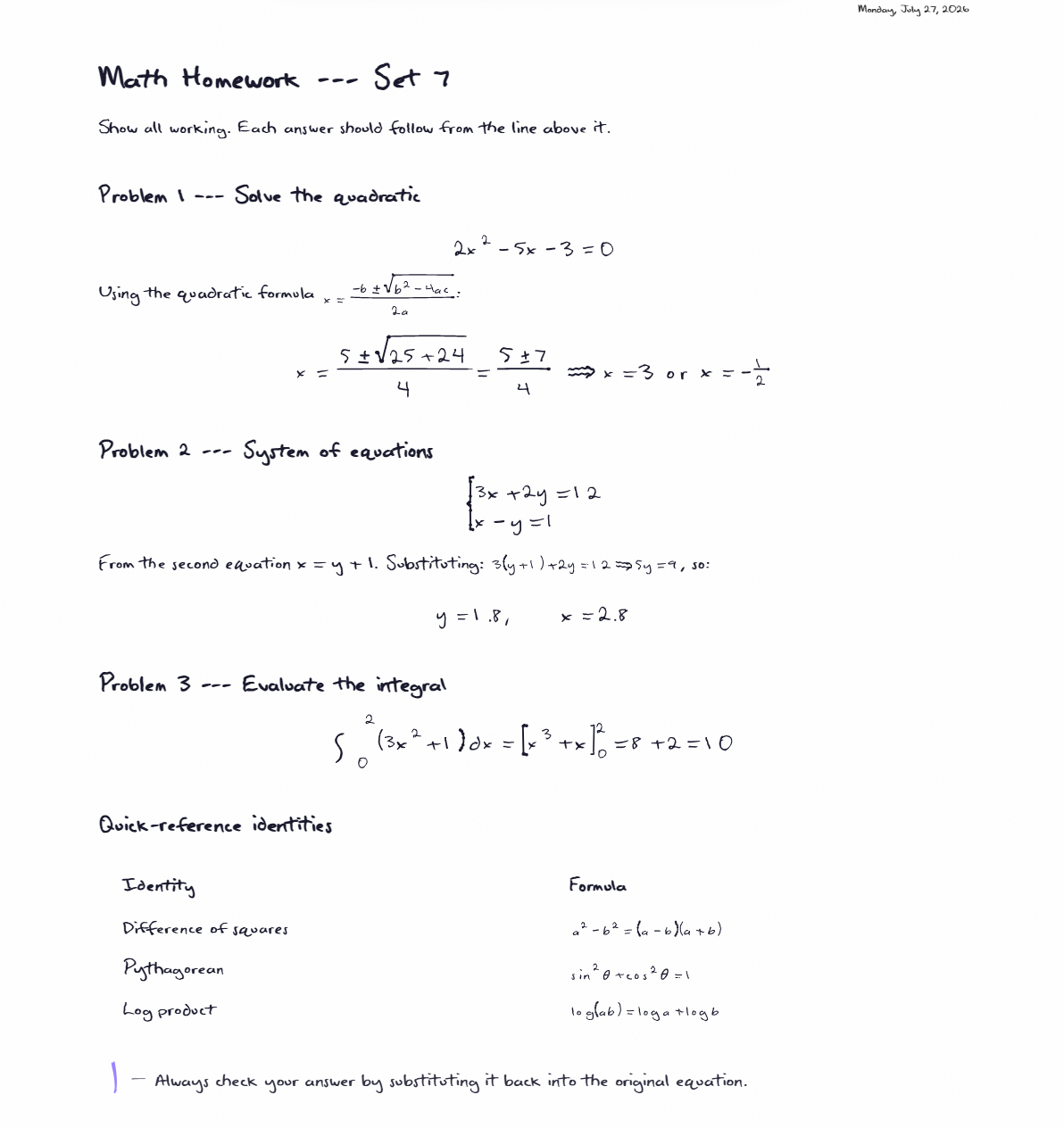
What genuine ink math actually means
Every other text-to-handwriting software behaves like a factory assembly line producing identical cars: every letter is stamped out, perfectly identical to the last. Human handwriting operates entirely differently. Imagine an artist painting a landscape — the hand moves naturally and creates tiny, unique variations in every single stroke. When you write an integral sign by hand, your wrist curves naturally, and the upper and lower limits settle comfortably into those curves.
The two essential challenges
Achieving this authentic look means solving two challenges:
- The layout must understand mathematical spacing. Fractions must stack vertically and cleanly. Matrix brackets must expand to hold all their internal numbers safely.
- The characters must behave organically. If your eye spots identical numbers repeating exactly the same way across the page, the illusion shatters completely. True ink math gives every single character a unique visual footprint.
Why standard typography falls short
All other text-to-handwriting software assigns a single font with a single, permanent shape to each letter. They force mathematical structures into a rigid horizontal box. When a font tries to handle stacked fractions, it collapses the structure into an unreadable single line, fundamentally altering structural integrity. The outcome? The result looks artificial and becomes difficult to read.
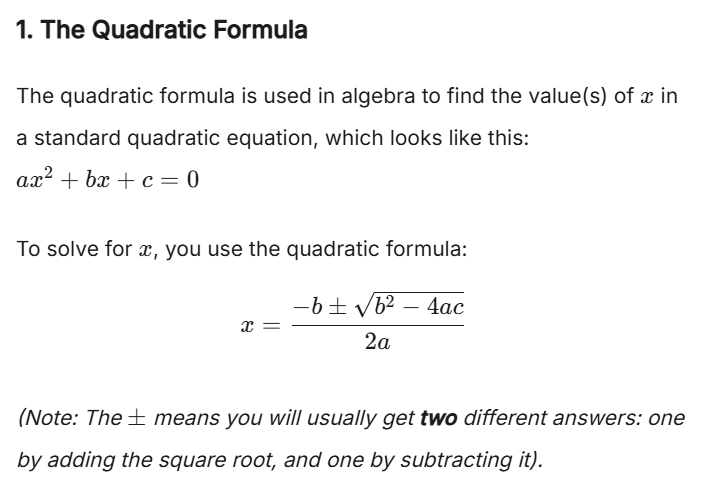
Figure: Digital math note. Every 'a' is the same.
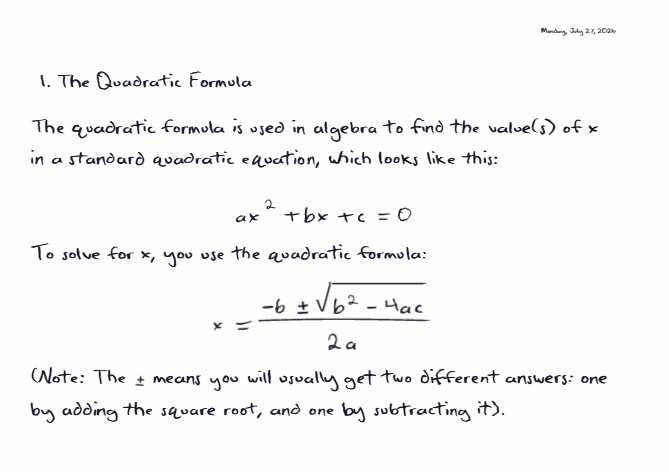
Figure: aipen.ink note. Every 'a' looks different.
Want to see your own equation written by hand?
Try it free →How our platform builds realistic pages
Aipen.ink separates the structural math layout from the visual ink drawing process — and solves each properly.
Step-by-step construction
First, the system analyzes your input as pure mathematics. It reads your commands and organizes the limits and radicals exactly where they belong to preserve structural integrity.
Next, it applies a humanization process to the entire document. Every single number, letter, and symbol is drawn from a vast collection of natural variations on the fly. You select your preferred ink color and choose between plain, lined, or dotted paper styles seamlessly.
Finally, it lets you download a professional-grade vector document to print. The finished note remains flawlessly crisp no matter how far you zoom in.
Common real-world applications
- Students can transform dense digital study notes into highly readable, memorable revision pages to accelerate learning.
- University candidates generate required handwritten assignments efficiently and cleanly.
- Educators design welcoming visual examples for their classrooms without spending hours writing by hand.
- Individuals dealing with motor injuries or tremors gain the ability to produce beautiful handwritten work effortlessly.
Frequently asked questions
Is this similar to a standard computer font?
Fonts draw every character identically. Our system varies every single character and builds proper spatial layouts for fractions and integrals, so the page mimics human writing accurately.
Can the system handle advanced formatting like matrices?
Yes. The system respects structural mathematics properly. It builds stacked fractions and perfectly aligned matrix brackets effortlessly.
Is the final document suitable for printing?
Yes. The system produces a crisp, scalable vector file ready for printing on any standard paper size.
Do I need to install heavy software?
No. Everything operates inside your web browser. You enter a prompt in a few words, and our platform handles the rest.
Create your own page today
Try putting your own calculus or physics formulas into the system and watch the digital text transform into a stunning handwritten document in less than 3 seconds. You receive three pages entirely free.
Try it for free →